


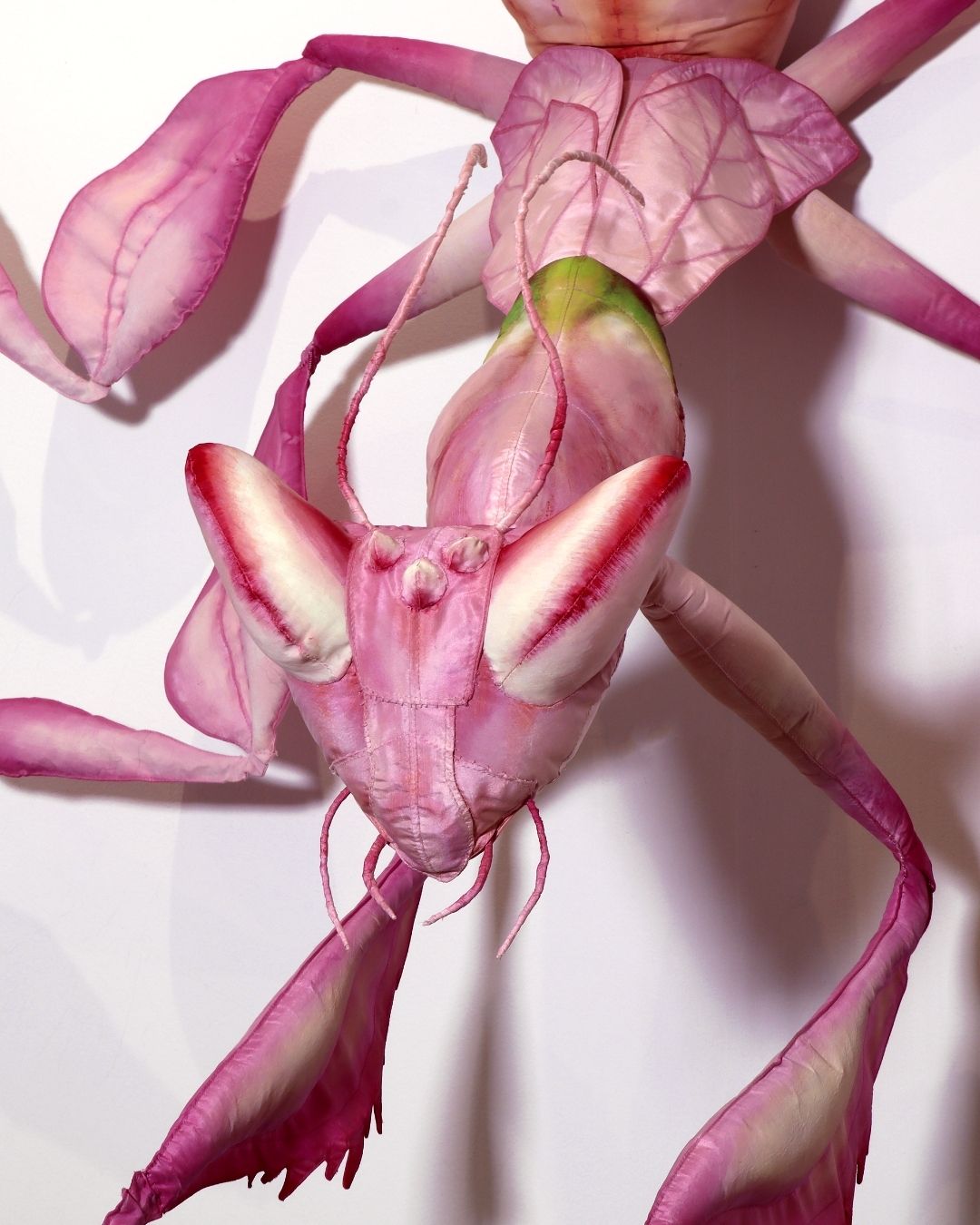
Phantom Kin: A Mutual Metamorphosis
Ava Katz
Opening Reception
May 22, 6 - 9 pm
Artist in Attendance
Artist Led Butterfly Workshop
May 23, 1 - 3 pm
Registration Required
Phantom Kin: A Mutual Metamorphosis draws on insect ecologies to reconsider definitions of the “natural”. Large-scale textile sculpture, sound, and text explore biomimicry as a natural survival tactic and a queer strategy, resisting rigid classification and destabilizing dominant paradigms. These pieces illustrate the importance of community and adaptability as integral components of resilience through adverse circumstances.
Insects are central protagonists within this body of work; their resilience lies in their capacity for transformation, collective intelligence, and reciprocal adaptation with their environments. Their survival is not rooted in dominance of their environment, but fluidity with it. By positioning plant-mimicking insects as mirrors for socially marginalized communities, I investigate visibility management, coded communication, and the tension between concealment and connection in politically hostile climates.
Three large sculptural works reference insects whose camouflage strategies blur the boundary between self and environment: a leaf-mimicking phasmid which reproduces through parthenogenesis, destabilizing binary reproductive structures; an orchid mantis whose disguise lures rather than hides, complicating gendered assumptions about passivity and power; and a thorn bug whose mimicry becomes most effective in collective formation, supported by vibrational communication and mutualistic alliances with ants. These works consider “passing,” queer signalling, and the vigilant calibration of identity required for survival.
A final large-scale sculpture extends through the space, replicating a root system or nervous network. Its branching structure references decentralized forms of intelligence shared across species: vascular systems, fungal mycelium, and insect communication pathways. These networks resist singular authorship and hierarchical organization, modelling mutualistic systems in which knowledge circulates laterally. Through these biological frameworks, I question anthropocentric measures of value and cognition.
The installation expands through trailing vines and botanical forms that envelop the viewer within a lush ecosystem. A soundscape layers insect droning and chirping into a harmonic composition, attuning the body to modes of communication that exist beyond human language. The exhibition becomes an invitation to integrate with ecological relationality, rather than observe it as an outsider.
An accompanying artist’s book combines prose, painting, interview, and photographic documentation to explore how queerness has historically been positioned as “unnatural”. By examining insect behaviors that disrupt cis-normative projections onto nature, the publication reframes fluidity and androgyny as intrinsic. Extending beyond the gallery, the book invites readers to unpack cultural presumptions and reimagine kinship across species boundaries.
Throughout Phantom Kin, I consider nature as a rhizomatic web of constant metamorphosis. The natural world is adaptive, improvisational, and defiantly diverse. By aligning queer embodiment with insect modes of being, I resist the weaponization of “nature” against those who diverge from dominant social structures. Instead, I propose that queerness is embedded within ecological systems as a natural form of existence.
This body of work champions even the smallest and most overlooked beings, asking what forms of community we might build through embracing interdependence over hierarchy. Insects teach us that survival is collaborative, intelligence is distributed, and transformation is ongoing. Through softness and sensory immersion, Phantom Kin invites viewers to inhabit a worldview in which mutual metamorphosis becomes a collective practice.
The exhibition features a Soundscape by Katherine Hillson and has an accompanying Artist’s Book co-authored with Violetta Leigh.
~
Ava Katz is a visual artist and educator based in Vancouver, BC. Drawing from a foundation in painting, they apply their knowledge of colour, texture, and composition onto large-scale textile objects, challenging traditional material hierarchies. Their practice is rooted in queer ecology, situating human, plant, and animal bodies on equal footing to question structures of dominance and categorization.
Katz received a BFA from Emily Carr in 2024 and was awarded the Bill Reid Scholarship. Their work has been exhibited in Vancouver, Calgary, and Bacău, Romania. They have been commissioned for film and gallery contexts, including Western Front (Vancouver). They have been interviewed for Akimblog and The Georgia Straight.
Alongside their studio practice, Katz has worked as a studio assistant to established artists such as Ruth Beer and Emily Hermant. They are also an active teacher, leading independent workshops and teaching sewing to young creatives at La Movida.
Katherine Hillson is a classically trained opera singer and experimental musician based in Montréal, Canada. Her research in the fields of medicine, religion, and bodily autonomy is presented in the written and performance works of “Sainerine”, her solo project. Sainerine invokes the operatic archetype of the fallen woman through piercing vocals and experimental electronics performance. Orchestral swells, ethereal synth textures, and shards of noise are laced together with Hillson’s sensibilities of classical composition.
Violetta Leigh is a writer, sculptor, and photographer. Her editorial, fiction, and poetry have been published in Aotearoa/New Zealand, Barcelona, Berlin, London, Los Angeles, Toronto, Vancouver, and Virginia. In addition, she writes artist biographies, exhibition statements, and marketing materials.
She is the author of three chapbooks: Drone Philosophy, Night Paces, and Absence Under the Electrics. In 2024, Void Set Press launched her first full-length book of prose poetry, Lights Under Concrete and Glass.
Leigh completed a BA at the University of Victoria, with a double major in Creative Writing and Environmental Studies. In addition, she is a Technical Writer certified with distinction by the British Columbia Institute of Technology. Most recently, she completed the Fundamentals of Wildland Fire Ecology and Management micro-credential with UBCO.
Her practice focuses on collaborative and innovative solutions to climate change and sustainability, as well as promoting the conservation and restoration of biodiversity, ecology, and ecosystem services.
~